

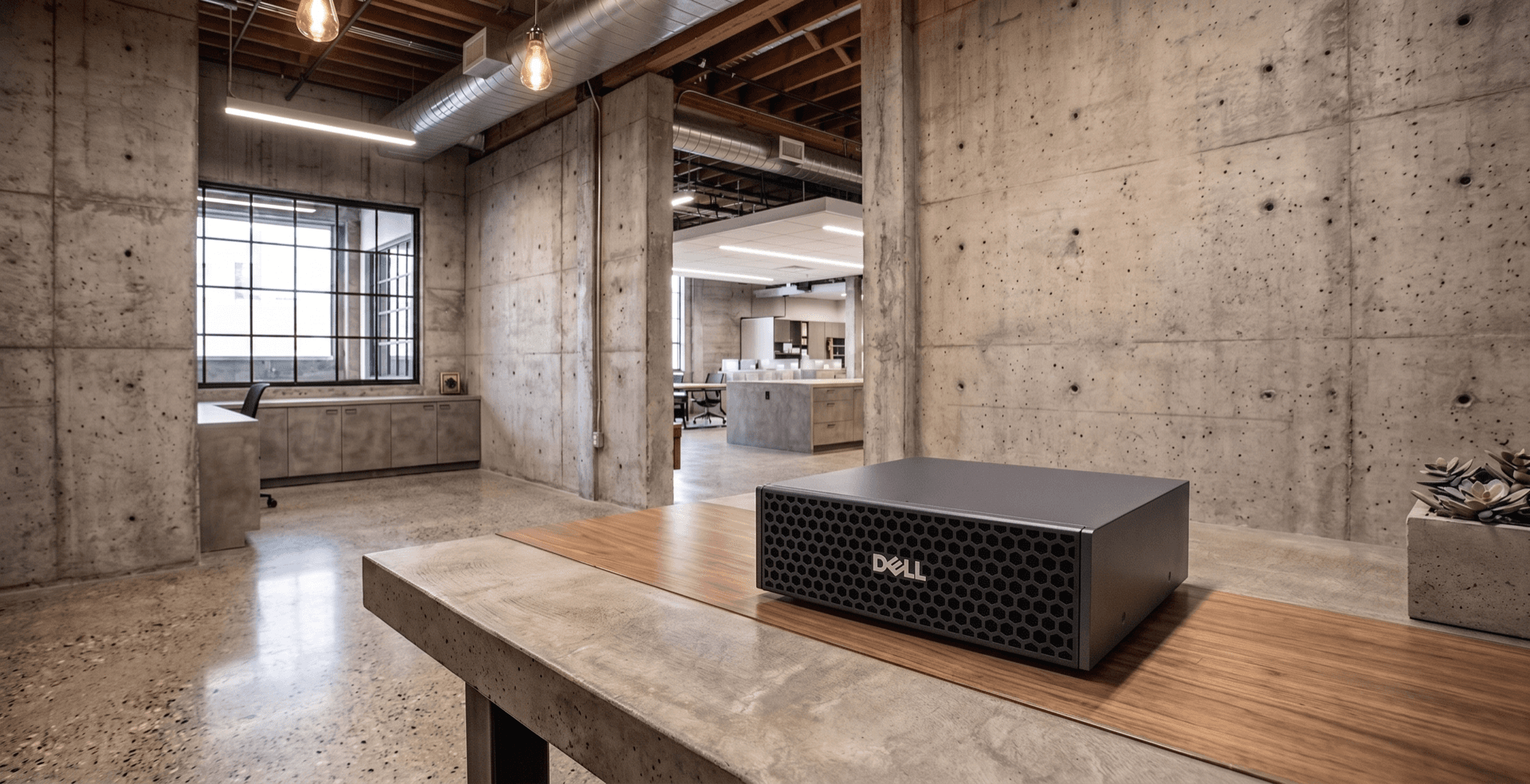
Grace Blackwell at the edge: adding the Dell Pro Max GB10 to Starlight
Starlight now treats the Dell Pro Max with GB10, NVIDIA's Grace Blackwell developer system, as a first-class cluster node. The Blackwell GPU and the local models that run on it are now part of the platform — managed, governed, and secured the same way every other Starlight node is.
For most of the last decade, datacenter-class AI meant a datacenter. Running a large model required a rack, a cooling plan, and a network path back to a cloud region. That assumption does not survive contact with a denied, degraded, intermittent, or bandwidth-limited (DDIL) environment, which is exactly where defense missions increasingly run.
We have closed that gap. Starlight now treats the Dell Pro Max with GB10, NVIDIA's Grace Blackwell developer system, as a first-class cluster node. The NVIDIA GPU and the local models that run on it are now part of the platform.
What we did
We brought the powerful GB10 into our clusters as another Starlight node. The full NVIDIA driver and CUDA stack and the Blackwell GPU come with it, so the platform gets all of that capability while managing the device like any other Starlight node.
From that point the GB10 is not a standalone appliance sitting next to the platform. It is inside the platform, scheduled, governed, and secured the same way every other Starlight node is. That distinction is the whole point. A GB10 on its own is a capable AI workstation. A GB10 as a Starlight node is mission infrastructure.
What the GB10 brings
The hardware earns its place. Translated into capability:
- The GB10 Grace Blackwell Superchip pairs a 20-core Arm CPU (10 Cortex-X925 and 10 Cortex-A725) with a Blackwell GPU carrying 6,144 CUDA cores and fifth-generation Tensor Cores. It delivers up to one petaflop, 1,000 TOPS, of FP4 compute.
- 128 GB of LPDDR5x unified memory is coherently shared between the CPU and GPU, so there is no host-to-GPU copy bottleneck. That single pool is what lets the device load a model up to roughly 200 billion parameters and work with it directly. Bond two GB10s over their ConnectX-7 links and that ceiling rises to around 405 billion parameters.
- Networking is built for clustering: a ConnectX-7 SmartNIC with two 200 Gigabit QSFP ports plus 10 Gigabit Ethernet.
- It does all of this in a package under six inches square and under three pounds, drawing a fraction of the power of a rack, and it is TAA certified for federal procurement.
Translate that for the mission: a model class that used to require cloud or rack now fits on a shelf, in a vehicle, or in an air-gapped space, and it runs there with no link home.
Why a Starlight node, and not just an appliance
On its own, a GB10 is a powerful AI workstation. Brought into Starlight, it becomes a managed node in the cluster, governed and secured the same way every other node is, and operated through the same control plane.
That is what turns the GB10 from a desk-side box into mission infrastructure. We can run AI models as containers directly on the GB10, putting the Blackwell GPU to work, and manage those workloads through Starlight alongside everything else in the cluster. Teams get local, GPU-accelerated inference without standing up or babysitting a separate appliance.
Mission impact
The result is real AI that runs where the mission is. A GB10 can sit at a desk, in a vehicle, or in a disconnected space and run large models locally, with the data staying on the device. Because it is a full member of the Starlight cluster, it is managed and operated like any other node rather than as a one-off. For our AI-driven efforts like Starlight Fabric, that means a capable local inference engine that travels with the mission instead of depending on the cloud.
What is next
This is the first NVIDIA GPU node in Starlight, and it will not be the last. We are extending the same approach across the rest of the Grace Blackwell line and validating bonded GB10 pairs as a standard edge inference building block.
If your mission is putting real AI in places the cloud cannot reach, this is what that looks like.
Keep your AI, data, and missions under your control, from the data center to the edge.
Keep reading
September 13, 2026
Kubernetes without the legwork: x0 in five demos
We have written about how x0 works. Now we want to show it. Five short terminal recordings take x0 from creating a Kubernetes cluster to provisioning s0 persistent storage, switching contexts, deploying and scaling an application, and inspecting it all in the x0 TUI.
August 12, 2026
Confidential compute, ready on arrival
Mainsail and HIPER Global are bringing together Starlight and the HG-5610-2UF rugged edge server as one integrated appliance, with Intel TDX confidential computing configured before shipment. The confidential compute foundation is ready when the system reaches the site.
May 8, 2026
Introducing Starlight
We've been quiet for a while. Mostly because we've spent the last year building. Starlight is an infrastructure platform for running VMs, containers, and AI workloads on hardware you already own.